Featured research
ANLN's overlooked nuclear role – visualized with MI–SIM
Summary
New research shows ANLN directly regulates transcription by organizing RNA Polymerase II condensates, revealing a nuclear role linked to cancer gene expression.
Known for its role in cell division, ANLN has now been shown to regulate gene transcription from within the nucleus.
New research from Professor En-Min Li's group at Shantou University Medical College, published in Nature Communications (Cao et al., 2025), reveals that nuclear ANLN binds directly to RNA Polymerase II (Pol II) and promotes the formation of large transcriptional condensates at gene start sites. These Pol II clusters are critical for driving expression of cancer-related genes, including those involved in Wnt signaling, oxidative processes, and cell differentiation.
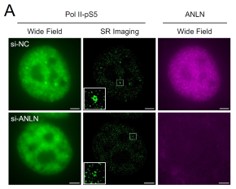
Figure A. Super-resolution images of Pol II-pS5 and ANLN clusters in control vs knockdown conditions.
Using MI-SIM super-resolution imaging, the team visualized the spatial organization of ANLN and initiated Pol II (Pol II-pS5). While both proteins formed nuclear condensates, ANLN was typically located at the periphery of large Pol II clusters. Disrupting ANLN through siRNA knockdown specifically reduced these large clusters (type III), without affecting smaller transcription-related condensates or protein levels.
To support these observations, the authors quantified Pol II cluster numbers and fluorescence intensity across multiple conditions. The data shown in Figure E (adapted from original Figure 3D–3G) confirm that reintroduction of wild-type ANLN restored large cluster formation, while mutants lacking nuclear localization or phase separation capacity did not.
Figure E. Cluster size classification and quantification, confirming ANLN's selective impact on large Pol II-pS5 clusters.
This nuclear function of ANLN is independent of its actin-binding role. Instead, the protein’s intrinsically disordered region (IDR) interacts with the Pol II carboxy-terminal domain (CTD), facilitating phase separation. The clinical relevance is reinforced by the use of THZ1, a super-enhancer inhibitor, which disrupts ANLN–Pol II condensates and suppresses tumor growth in ESCC cell models.
The findings reposition ANLN as a nuclear regulator of transcription and point to new ways of targeting tumor growth through condensate disruption.