Featured research
Investigating organelle connections in plants
Summary
A recent review highlights how the endoplasmic reticulum forms membrane contact sites with multiple organelles in plant cells, enabling coordinated signaling and structural dynamics.
A recent review in New Phytologist explores how the endoplasmic reticulum functions as a central hub in the plant cell's internal network, forming membrane contact sites (MCS) with nearly every other major organelle. These nanoscale connections between the ER and organelles such as mitochondria, chloroplasts, the plasma membrane, peroxisomes and the Golgi allow for tightly regulated exchange of signals, ions and lipids.
In plant systems, the composition and behavior of MCS differ from other eukaryotes. Many of the proteins involved are either unique to plants or part of expanded gene families, including VAP27, NET3C, MCTPs and SYTs. These tethers often integrate ER membranes with the cytoskeleton, allowing the ER to act as both an anchor and a platform for rapid structural rearrangements in response to developmental and environmental cues.
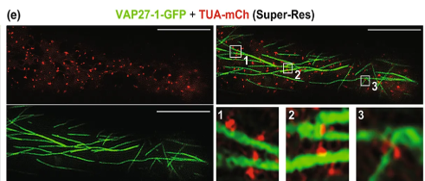
Figure 3e. Super-resolution imaging of VAP27-1-GFP (green) and TUA-mCh (red) reveals nanoscale ER–microtubule associations in plant cells.
ER–plasma membrane contact sites (EPCS) are currently the best-characterized. They have been implicated in regulating calcium dynamics, lipid homeostasis, and membrane curvature during mechanical or osmotic stress. Emerging evidence also points to ER–mitochondria and ER–chloroplast contacts as playing roles in organelle positioning and metabolic coordination.
This complexity has historically been difficult to observe directly. CSR Biotech's MI-SIM super-resolution imaging is changing that. MI-SIM can resolve key proteins such as VAP27 at ER contact sites, making it possible to track the formation and rearrangement of these interactions in living plant cells. This gives researchers the ability to observe how organelle contacts adapt in real time under stress or during cell development.
This work highlights the growing understanding that organelles in plant cells function within an interconnected physical and regulatory framework. The ER lies at the center of this system, coordinating processes that affect everything from energy production to membrane dynamics.
Read the full article: https://doi.org/10.1111/nph.18745