Featured research
New study shows how ARL3 mutations disrupt cilia transport – revealed with MI–SIM imaging
Summary
A FASEB Journal study shows how ARL3 mutations alter intraciliary transport, with MI-SIM imaging revealing mislocalization of IFT88 and structural changes in cilia.
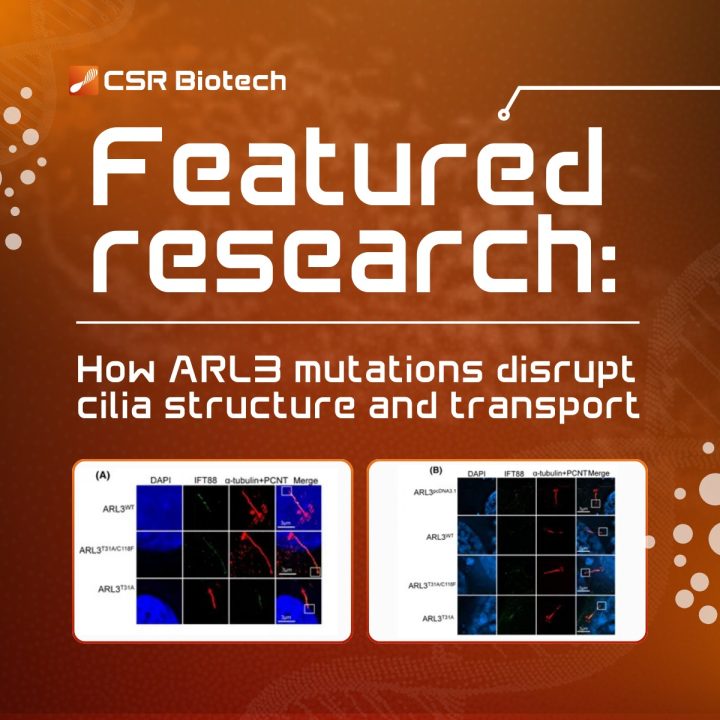
A new publication in The FASEB Journal highlights how CSR Biotech's MI-SIM technology has uncovered critical differences in cilia structure and function in cells with ARL3 mutations. The work focused on fibroblasts derived from patients with two specific variants: ARL3 T31A and the compound heterozygous ARL3 T31A/C118F mutation.
Using MI-SIM, researchers were able to visualize the positioning of IFT88, a key protein in intraciliary transport. In wild-type and T31A-only cells, IFT88 localized at the base of the cilia. However, in cells with the T31A/C118F variant, IFT88 was abnormally accumulated at the tip, indicating disrupted retrograde transport.
This disruption was associated with significantly elongated cilia and changes in gene expression across pathways involved in neuron projection, tissue structure, and TGF-β signaling. Proteomic analysis supported these findings, revealing downregulation of key genes such as IQUB, GRIP1, and RAB3IP. Notably, restoring IQUB expression helped reduce cilia length in affected cells.
These findings deepen understanding of how different ARL3 mutations influence ciliopathy mechanisms and show how super-resolution imaging can reveal changes not detectable by standard methods.
Read the full research: https://doi.org/10.1096/fj.202301906R