Featured research
Nuclear stress bodies unlock NFIL3 to control inflammation
Summary
A Cell study shows how nuclear stress bodies reshape genome structure in real time, activating NFIL3 and modulating inflammatory responses.
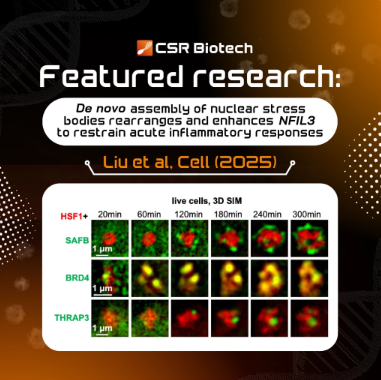
A new study in Cell uses high-resolution live imaging to reveal how nuclear stress bodies (nSBs) actively reshape genome structure and control inflammatory responses.
Under stress conditions such as heat shock or sodium arsenite exposure, satellite III (SatIII) loci rapidly expand and transcribe SatIII RNAs. Using MI-SIM super-resolution microscopy, researchers tracked this process in real time, showing how SatIII DNA domains double in volume within two hours of stress, transforming silent heterochromatin into transcriptionally active compartments.
These expanded regions scaffold nuclear stress bodies, which then pull nearby immune-regulatory genes like NFIL3 into closer spatial proximity. MI-SIM imaging captured this repositioning live, showing NFIL3 loci moving closer to SatIII sites and becoming transcriptionally active. ATAC-seq confirmed increased chromatin accessibility at the NFIL3 promoter, while ChIP-qPCR showed enhanced binding of stress-responsive transcription factors HSF1 and BRD4, both recruited into the structured layers of nSBs.
In immune cells including PBMC-derived macrophages, NFIL3 upregulation dampened key inflammatory cytokines (TNF, IL-1β, IL-8). When SatIII RNAs or NFIL3 were experimentally knocked down, cytokine expression surged.
Importantly, in 150 septic patients, higher SatIII and NFIL3 expression correlated with lower cytokine levels and better 28-day survival. ROC curve analysis found SatIII expression to be as predictive as clinical SOFA scores, with combined markers offering improved prognostic power.
This study reveals a primate-specific nuclear stress response that structures the genome in real time, visualized with MI-SIM, and directly controls inflammatory output through NFIL3. It introduces SatIII RNA as a potential biomarker and highlights nuclear stress body architecture as a potential therapeutic target in sepsis and inflammatory disease.
Read the study: View full paper