Featured research
Overcoming vesicle traps in live-cell imaging: a new step forward for super-resolution
Summary
A study in ACS Applied Nano Materials presents a peptide-based delivery system enabling efficient cytoplasmic delivery of fluorescent nanoprobes, visualized using MI-SIM imaging.
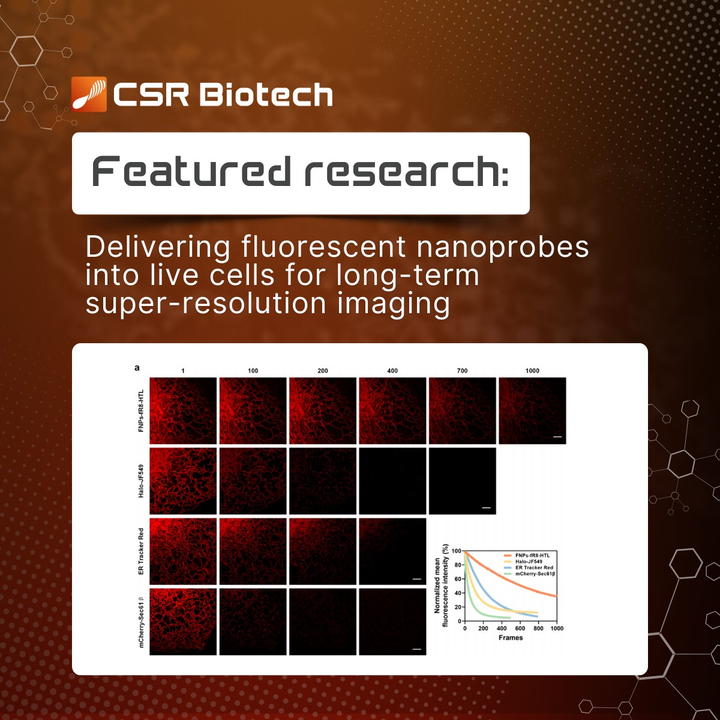
Live-cell super-resolution imaging has long been limited by one critical challenge: the entrapment of fluorescent nanoprobes (FNPs) inside vesicles. This has made it difficult to visualize dynamic processes in real time at the subcellular level. A newly published study in ACS Applied Nano Materials offers a major advance, with CSR Biotech's MI-SIM technology playing a key role.
Researchers developed a novel peptide-based delivery method using fR8, a cell-penetrating peptide that enables direct cytoplasmic delivery of 3.5 nm FNPs. Unlike conventional delivery systems, fR8 allows nanoprobes to bypass vesicular compartments and enter the cytoplasm with high efficiency, reaching up to 75.6%.
The study also demonstrates the successful integration of this delivery system with protein tagging technologies. Using HaloTag and fR8-modified FNPs, researchers achieved precise, long-term labeling of specific organelles such as the endoplasmic reticulum and mitochondria. This enables high-resolution tracking of subcellular interactions over time in living cells.
MI-SIM was instrumental in capturing these long-term dynamics. Its high sensitivity and optical clarity supported extended imaging sessions with minimal photobleaching, making it well suited for tracking intracellular processes over time.
This research improves the practical use of FNPs in super-resolution imaging and expands their application in live-cell studies. It represents a step forward in understanding how organelles interact dynamically within living systems.
Read the full study: https://doi.org/10.1021/acsanm.3c05423