Featured research
RNA editing meets super-resolution: tagging endogenous proteins with RENAPT and MI–SIM
Summary
A Nature Chemical Biology study introduces RENAPT, a reversible RNA-based method for tagging endogenous proteins, combined with MI-SIM imaging for high-resolution live-cell visualization.
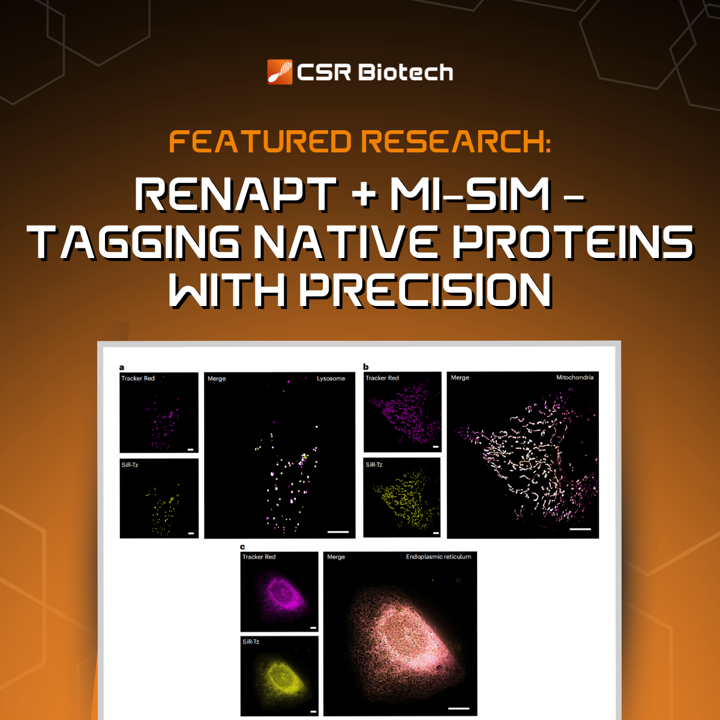
A recent Nature Chemical Biology paper introduces RENAPT, a method for site-specific tagging of endogenous proteins in live cells using RNA editing and noncanonical amino acids (ncAAs). Unlike genome editing approaches, RENAPT is temporary, nonheritable, and not constrained by PAM sequences, making it broadly applicable across gene targets.
Using fluorescent ncAAs or ncAAs with bio-orthogonal handles for dye conjugation, the researchers demonstrated successful labeling of a range of endogenous proteins at their physiological expression levels and subcellular locations. The method also supports dual labeling of two proteins simultaneously with different ncAAs.
To visualize these tagged proteins at high spatial resolution, the team used MI-SIM, a structured illumination microscopy technique developed for live-cell super-resolution imaging. MI-SIM imaging clearly showed co-localization of RENAPT-labeled proteins with commercial organelle markers, including mitochondria, lysosomes, and the endoplasmic reticulum, validating the specificity and spatial fidelity of the RENAPT approach.
Notably, the method was also applied to primary neurons, enabling live-cell tracking of ion channels and neuron-specific proteins, supporting studies of dynamic processes in the nervous system.
RENAPT, in combination with MI-SIM, provides a toolkit for visualizing native protein localization and dynamics in living systems, without the need for genetic overexpression or permanent genomic alteration.
Read the full study: https://doi.org/10.1038/s41589-023-01533-w